Recently, I had a discussion with another blogger about some of the stories I’ve written that reflect my family background. Most of what I know came through stories my mother told me. I’ve always known I was of Ashkenazi Jewish descent and that my grandfather came from Poland around 1903 at the age of 19 with “nothing but the clothes on his back.” According to my mother, he was a self-taught tailor.
I was never really close to my grandfather. In retrospect, there are so many questions I wish I’d asked him. But as a cousin and I’ve agreed, he might not have answered them. The following story is one that molds fact and fiction into the conversation I never had with Grandpa.
***
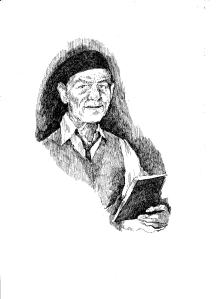
Original Artwork © Rochelle Wisoff-Fields
SMILING SAM
“Mom, do I havta go?”
“You’re his baby granddaughter.”
Rhoda Wiseman popped a piece of bagel slathered with cream cheese into her mouth. She savored it on her tongue and chewed with slow deliberation. How could she worm her way out of this weekly torture?
“I need to stay home and do my homework”
Mom picked up a ceramic salt shaker from the ten-year-old Tappan range and pretended to speak into it as if it were a microphone. “Sunday, July 18, 1965. Schools in Kansas City are out for the summer and you are there.”
“You want me to be prepared for junior high, don’t you?”
“Nice try.”
“Tricia just got a new bike. She says I can take it for a spin today.”
“You can ride when we get back, and don’t talk with your mouth full.”
Rhoda studied her mother for chinks in her armor. Swallowing with an exaggerated gulp, she slurped her milk and slammed down the aluminum glass with a clank-thump on the Formica counter. “They go to church on Sunday nights.”
“I wish you’d find some nice Jewish kids to play with.” Mom muttered and lifted the metal basket from the coffee percolator. She dumped the grounds into the garbage can under the sink. “We won’t be there that long and being obnoxious won’t help. Now finish your breakfast and then go get dressed.”
Sliding off the stool, Rhoda dropped down on the cool tile, embraced Mom’s knees and planted frantic kisses on her shins. “Please, Miz’ Wiseman have mercy. Whip me. Beat me. But don’ make me gooooo!”
Rolling her eyes, Mom swooshed her hand through the air like a soaring eagle and then pressed the back of it against her forehead. “Enough, Sarah Heartburn.”
Standing, Rhoda leaned her head on her mother’s shoulder and sniffed, making puppy noises. Tabu cologne swelled her nostrils. “You smell so nice, Mommy.”
“Flattery won’t work either. You’re going and that’s final.”
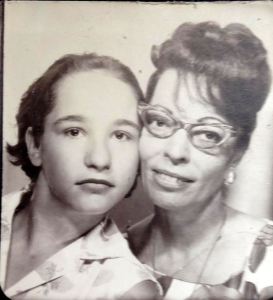
After two hours of begging, fuming and fretting, Rhoda slouched beside her mother in Grandpa’s living room. She tilted back her head until her neck ached and watched the second hand trudge past the Hebrew characters on the wall clock over the divan. She tippy-tapped the rhythm with her toes, making screaking noises on the heavy plastic slipcovers under her sweaty thighs, until Mom’s frost-chilled glare said, “Cut it out or else!”
Slumping forward, Rhoda dug her elbows into her knees, propped her chin on her hands and concentrated on a pair of lead-crystal seals on the coffee table. The two figures faced each other with balls perched on their noses. Shimmering sunlight made amoeba-shaped patterns through the smooth-glass curves.
She watched Grandpa’s inverted image, distorted in the translucent orbs. His dual reflections faded into an astral haze. From somewhere in outer space a voice intoned her name.
“Rhoda! Grandpa asked you a question.”
Snapping open her eyes, she felt heat rush from her neck, all the way to her forehead. She forced the corners of her wooden mouth to bend. The old sourpuss didn’t return her smile.
His rawboned fingers, yellow-stained and freckled, curved around his easy-chair’s armrests. Sunken into the threadbare seat cushion, his timeworn torso blended in with it. Concave cheeks, stippled with day old bristle flanked a pockmarked bulb of a nose. His eyes, a mix of tenebrous blue and somber gray, scourged her with an implied tongue lashing.
“Your mother says you read. What do you read?” His thick accent and gruff voice scathed her.
“I—I’m reading The Diary of Anne Frank. And I—um—I like Sholom Aleichem’s stories.”
“Your mother also tells me you go to church?” The last word spat out like an unexpected mouthful of curdled milk.
“Once. With Tricia. Just to visit.”
He shrugged. “Visit ‘sh’mizzit’. Too much time you spend mit Goyim.”
Rhoda heaved an inward sigh when he turned his attention back to Mom. “Evie, this girl’s alone too much.”
“I make good money, Dad. We need the extra income.”
“What about Nathan?”
“The restaurant takes a lot of work. He’s just beginning to break even.”
Grandpa flew into a Yiddish tirade.
Rhoda was glad she didn’t understand his words, although she had a pretty good idea of their meaning. Every visit eventually led to his low opinion of the man, a nominal Jew, who’d “spitefully” married his daughter and wooed her away from her family’s orthodoxy.
Mom stood, the hurt in her chocolate-brown eyes thinly masked by a Max Factor smile, and picked up her purse. Leaning over, she squeezed his angular shoulder. “Take care of yourself, Dad. Call if you need anything.”
Without looking up, he nodded and lit a half-smoked cigarette, as crumpled as the man himself. Leveling his lethal eyes on Rhoda he pointed at her with a gnarled finger. “Remember your tribe.”
Afterward, Mom took her to Wimpy’s Drive-In for an Italian steak sandwich and a Coke. They sat at the counter on tall stools in the concrete and glass enclosure that had been added so patrons could enjoy “inside dining.”
Onion and hamburger aromas, like favorite playmates, frolicked about the cramped space. Relishing the grease-laden air, Rhoda dredged a French fry through a ketchup mound. “Do you have to tell him everything?”
“He’s your grandfather.”
“I suppose you told him how much I hate visiting him, too.”
“Of course not. It would hurt his feelings.”
Rhoda’s mind flashed back five years to her brother’s bar mitzvah. Fresh-faced and golden in his new suit and fringed prayer shawl, he took his place on the bema, the platform in front of the congregation, before the Torah scroll. The sanctuary echoed with his melodic cantillation. Afterward, the rabbi proclaimed him his star pupil. Even Dad, who rarely attended services, beamed.
Over tables loaded with sweets and melons, guests piled their plates and sang Aaron’s praises.
“Such poise.”
“What a voice.”
“A future cantor.”
What did “Crabby Appleton” have to say? Did he compliment his grandson’s impeccable pronunciations? Commend him for his hard work? Ha! Although Aaron had only made a couple of mistakes, the old buzzard couldn’t wait to point them out in front of everyone.
No, she decided, Smiling Sam, as Daddy called him, was the coldest of all cold fish. “Feelings? What feelings?”

Two weeks later, Dad, the music aficionado of the family, brought home a record. “Especially for Rhoda.” He lifted the console lid, took the disk from its cardboard sleeve and lowered it onto the spindle. “New Broadway play.”
She stretched out on the carpeted floor, folding her arms behind her and listened to familiar characters leap from the pages of her books.
“A fiddler on the roof. Sounds crazy, no? ” Zero Mostel, as Tevye the milkman, spoke over the solo violin, introducing the villagers of Anatevka before leading the cast in the song, “Tradition.”
Mom, dusting knickknacks, swayed to the Klesmer style music. She set a figurine on the “what-not” shelf above the stereo. “You know who’d love this record?”
The following Sunday, at the dinner table, Rhoda suffocated under the weight of Grandpa’s scrutiny. He watched her every move, commenting on what she ate, how much she ate and the way she held her fork. Why did Mom have to invite him over? Couldn’t she have just loaned him the record?
He carved his steak into square chunks; each one the same size and shape. Spearing one of them with his fork, he tangled his lips around it and chomped it between his clacking false teeth. “Nu? Where’s Aaron?”
“Out with the guys for a final hurrah before he leaves for M.U. He said to tell you how sorry he is to miss you tonight, Sam.” Dad winked at Rhoda who choked on a giggle.
In his haste to make his getaway, Aaron had caught his toe on a sidewalk crack and tumbled headlong into the hedges. Leaves clinging to his hair, spitting dirt and sticks, he stumbled to the car. “Call me when the coast is clear.”
Rhoda tossed the last bite of salad into her mouth and stacked her empty plates. She bolted from her chair to the kitchen. “I’ll wash the dishes.”
Mom followed her. “They can wait.” She lowered her voice. “It won’t kill you to join us in the living room.”
Rhoda groaned; her ulterior motive thwarted. “But I’ve heard the record a dozen times.”
“One more time! With feeling!” Mom turned to leave, halted and sent a searing gaze over her shoulder. “Remember, Rhoda. Hurt people hurt people.”
“Remember this. Remember that.” Muttering under her breath, Rhoda plopped down on the round eggshell-blue loveseat the Wisemans fondly referred to as the “cuddle chair”.
Grandpa eased himself onto a straight-back chair beside the stereo and laid his hands on the arm rests. Mom patted the sofa cushion. “Dad, wouldn’t you be more comfortable here?”
He pointed to his ears that hung like draperies on either side of his gaunt and balding head. “Not so good the hearing.”
“Now for the pièce de résistance.” Dad set the needle in position on the record and twisted the volume knob. “Enjoy!”
If Grandpa did enjoy it, Rhoda couldn’t tell from his expression; an impenetrable; brick wall with cement reinforcements.
On the third cut, Tevye lamented his poverty to God and then broke into song. “If I were a rich man ya ha dee ha dee ha dee ah dee a deeya deeya dum, all day long I’d biddy biddy bum if I were a wealthy man.”
In a stunned moment Rhoda would remember the rest of her life, Grandpa’s gravel-hard eyes transformed to liquid quartz. The staid precipice of his stolid chin quivered and the immutable line above it trembled upward at each corner. “My father sang just like dat.”
Her paradigm forever shifted, she dreamed that night of Jewish people in Czarist Russia. They clasped hands and danced around one man. Instead of Tevye the milkman, she saw Sam the tailor, arms upraised and a broad smile on his face.
The next morning she coaxed open her crusty eyelids. Pain stabbed her temples and her throat felt like she’d swallowed broken glass. She shivered and pulled the blankets around her neck. “Mo-om, I don’t—cough, cough—feel good.”
Mom, in her sleep-wrinkled nightgown, her hair swathed in toilet tissue to preserve her weekly salon investment, shuffled into the room. Sinking down on the bed, she slipped a thermometer under Rhoda’s tongue. She counted three minutes by the clock, took it out and held it up to the light with an apologetic shake of her head. “101º. Dad’s already left and Aaron spent the night with his friends. I’m afraid you’ll have to stay with Grandpa.”
Rhoda moaned. “I’m old enough to stay by myself.”
Snuggling under a feather comforter on the couch in Grandpa’s spare room, Rhoda snoozed most of the morning.
From the basement below his sewing machine’s whir and click soothed her. Even though he’d retired ten years ago, he still did some odd tailoring jobs from home. Mom said it kept his fingers agile and his mind alive. Rhoda snickered. “Alive” was never a word she would ascribe to her craggy grandfather.
By mid afternoon her febrile headache subsided. She sat up and surveyed the stark-white room that boasted no pictures to break the monotony. Against one wall stood a half-full bookcase with a portable TV on the top shelf. An antique bureau graced the opposite wall.
A ragged, leather-bound photograph album on the end table beside the couch intrigued her. A yellowed note written on parchment in a foreign script lay on top of it. She rolled onto her side and reached for it.
“You’re feeling better, yes?”
“Much—” Yanking back her hand, she looked up, expecting his usual condemnation-glare. Instead, his eyes bore an unfamiliar softness. “—better.”
“Still warm.” He pressed his cool palm against her forehead, gently pushing her back to the pillow.
“You want to see?” Scooting a chair to the couch, he sat, laid the album in his lap and opened it. He skimmed his finger over a photograph of a bearded man and a woman wearing a hair-covering babushka. In front of them stood two children; a boy in knee pants and girl with waist-length curls. Grandpa’s thumb caressed her image. “Fayga. Meineh schvester. My sister. She is ten there. I am five, I think. Mama. Papa. Killed soon after this.”
“My great grandpa?” Rhoda’s heart banged against her chest. “The one who sang like Tevye? How?”
“Pogrom. Murdering Cossacks. Fayga and me, we hid under the bed.”
“You saw?”
“I saw.” Turning his face to the window, he shut his eyes. “They burned first the synagogue. Rosinia, our shtetl, our village, our friends, our lives—gone.” He snapped his fingers. “Like dat.”
After a few minutes of tight silence, he opened his eyes and turned back to Rhoda. “Fayga, mit a doll’s face.” Encircling her hand in his, he raised her fingers to his lips. “You look just like her.”
Rhoda’s cheeks blazed. Questions stuck in her throat like cold oatmeal.
Grandpa let go of her hand and continued to speak. “Again the Cossacks come to Poland to ‘recruit’ soldiers into the Russian army. It’s 1903. I am seventeen and live in Anapol with Fayga and her husband, Yankel, and their twin daughters. She hides me under a pile of diapers and soiled clothes. Oy, the stink.” He grinned like a schoolboy and pinched his nose. “The Cossacks don’t like it much either. They leave. Fayga kisses me and shoves me out the back door.” Grandpa’s smile dissolved. “‘Go,’ she says. ‘Go to America.’”
“You came by yourself when you were Aaron’s age?”
“Like an animal in the ship’s steerage level.” His eyes became faraway shadows. “When I come to New York—Ellis Island—I have no one.”
“How did you get to Kansas City?”
Grandpa pulled a pack of cigarettes from his shirt pocket. Sliding one out, he poked it into his mouth. He took a matchbook from the same pocket, tore off a match and struck it. Lighting the cigarette, he sucked it and hissed a smoke stream through pursed lips. “To see dis old man now you would not know what a clever boy he was. And at dat time I don’t speak English.”
“Who taught you?”
“You live on the street, you learn quick.”
He turned the album page and showed her a leaflet with the drawing of a man on a horse on the front. “I decide I will go to Texas and be a cowboy.”
“This isn’t Texas, Grandpa.”
“My granddaughter, the genius.” He waved his thumb in the air. “Sometimes I get a ride—a meal, a bed to sleep. A job here and there. Weeks. Months. Pennsylvania. Ohio. Illinois. And so on.”
Rhoda hugged her pillow to her chest and sat upright. “Wow! You must’ve had gobs of adventures! What was it like?”
“Stories for another time, yes?” Grandpa pinched her cheek and set the album back on the end table. “On Friday night I reach Missouri. I’m hungry and tired. I find a synagogue. A widower who lives alone with his daughter invites me to spend Shabbes with them. So Cowboy, ‘sh’mow-boy’, I become a tailor and marry the prettiest girl in Kansas City, may she rest in peace.”
“What happened to Aunt Fayga and Uncle Yankel and the twins?”
He picked up the note that had fallen to the floor and translated. “‘24 August 1940. My dear brother Shmuel, Thank you for the check. With what we have saved it is enough for all of us to leave Warsaw. We cannot wait to see you.’” He ground out his cigarette in the bottom of an empty coffee cup. “After dat—nothing.”
Paralyzed with revelation, Rhoda stared at her quivering grandfather, his eyes heavy with fresh sorrow. His past became her present. Huddled between a dirt floor and a musty bed, she watched Cossacks breaking through the door. Shuddering, she heard the Nazis goose-stepping by, their thick boots clopping on the pavement.
Sliding onto his lap, she snuggled against him.
“Tonight, I will tell my grandson.” Grandpa crushed her in his embrace. “Wonderful Bar Mitzvah.”
Story published in

Available Here on Kindle.
A few print copies available from the Author. Runtshell@gmail.com

 Rochelle Wisoff-Fields-Addicted to Purple