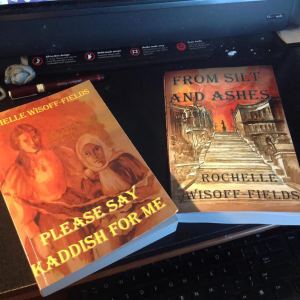
My journey continues, putting one foot in front of the other. When I began to write PLEASE SAY KADDISH FOR ME I knew I had a story to tell. I pitched it as “The Dark Side of Fiddler on the Roof.” I wrote, rewrote and edited Havah Cohen Gitterman’s story, thinking I would stop with this one book. However, the voices in my head compelled me to continue the saga with FROM SILT AND ASHES.
At a point where I thought I’d completed the first two books I began to write AS ONE MUST, ONE CAN. However, I had to stop to go back to the first book..and the second book. For five years the third book languished in an unopened Word doc. file. When I returned to my 60,000 word, unfinished manuscript, I found that my characters had grown, changed and gone in different directions than I’d originally anticipated. Not to mention that, after ten years I had also grown and changed as a writer. Perhaps 20,000 of those original 60,000 words survived the overhaul.
My agent, Jeanie Loiacono and W& B Publishing turned up the heat this summer by giving me a July deadline with the promise of a contract. Setting aside all writing time to devote to Havah, I sent Friday Fictioneers into reruns.
COMING SOON!
My story has a happy “ending.” The manuscript has been submitted and approved. Contracts with both agent and publisher are signed. Artwork for the inside of the book is complete and I await the proof copy to make any last minute edits.
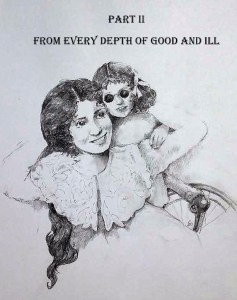
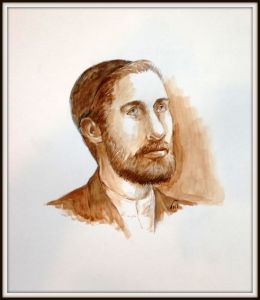
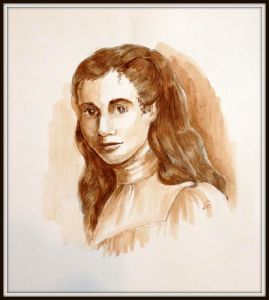
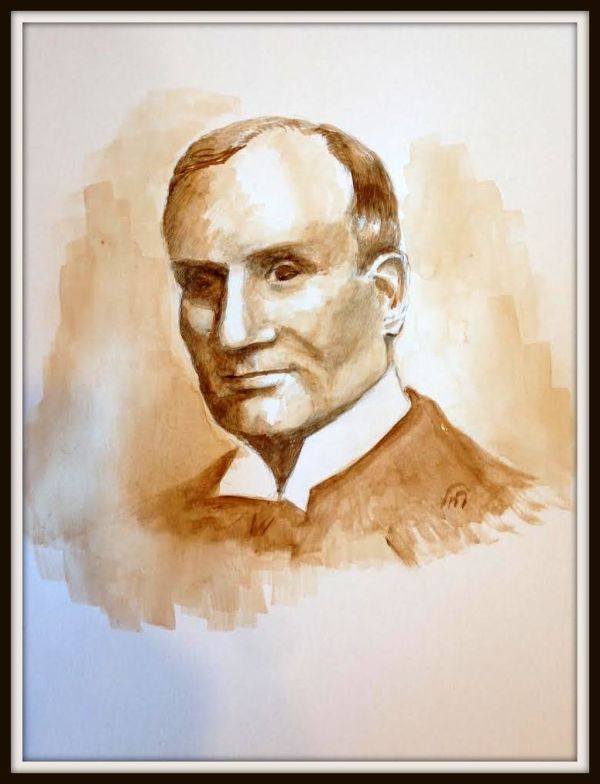
Below are the divider pages for AS ONE MUST, ONE CAN to whet your appetite.
The following photo is the PROMPT. It’s a first run, never before seen by Friday Fictioneers. PLEASE…because it’s PROPER ETIQUETTE…give credit to the photographer somewhere in your post. Vijaya Sundaram this week. Thank you.
Enan’s grandiloquent notes set off explosions in my heart. I kept every embellished missive in a gilded box. His purple prose enslaved me.
After every beating or tongue lashing, he would gift me with an impassioned written apology and weep until I absolved him of his guilt.
One day he left our cottage whilst I slept. A card on the nightstand, penned in his sweeping hand simply said, “Goodbye.”
***
I wanted to search for him—beg him to come back. Instead, a fountain of sparks illumes the black sky. His words scatter amid the ashes and my spirit soars.
Summer is the time for vacations, picnics on the beach and reruns on the telly. I’m happy to announce that I made my July deadline for my third novel in my series entitled AS ONE MUST ONE CAN. It looks like there’s more work to be done, however. Many thanks to those of you who responded to my plea for your favorite reruns. Look for new prompts the beginning of September as I’ve received quite a few new ones this summer.
The following photo is the PROMPT. This week’s retread request is from Dee Lovering If you’re one of those who wrote a story for this prompt feel free to re-post it and enjoy the respite. Remember that all photos are private property and subject to copyright. Use other than Friday Fictioneers by permission only.
Logan hunched his shoulders against the icy North Atlantic wind.
“Me wee Patrick’s one tomorrow.”
“Dinnae fash yersel,” said John, the coxswain. “The morrow’ll be the cold start of May and there’ll be eight more months of 1912 to play with the boy.”
“Two points starboard, John,” said Logan from the bow as he readied the boat hook.
***
Four months later the memories of the baby they pulled from the water tormented Logan. Patrick’s cries woke him from a nightmare. He gathered the child into his arms and whispered.
“Let fly, lad. ‘Tis a hard life, but a good sign.”
Four times a year a group of writers from all over the Midwest and beyond gather to share writing and marketing tips. Often agents and editors are invited to share their expertise and take pitches from aspiring authors. The conferences are free to members, save the motel fee and food costs.
With fellow authors Caroline Giammanco and Diane Yates
Madison Woods, OWL friend and creator of Friday Fictioneers.
My first time at a conference was in the summer of 2007. I’d “completed” PLEASE SAY KADDISH FOR ME and was interested in finding an agent. I really didn’t expect to find anyone in an organization with the word Ozarks to be interested in my Jewish historical novel.
How wrong can a person be? I found not only interest but a group of generous mentors. Each time I went to a workshop, I learned something new which precipitated a rewrite. One of the most significant classes was on how to pitch a book to an agent in five sentences.
Jeanie Loiacono and Me
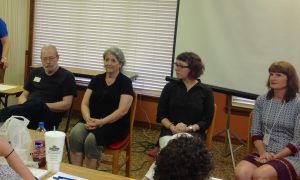
The panel: Publisher Duke Pennell, Publisher Lou Turner, Editor Alex Hess, Agent Jeanie Loiacono
Over the years I’ve made some good friends and met people who have been instrumental in changing my life. The first is Lou Turner, founder of High Hill Press. In 2010, after I’d submitted short stories to ECHOES OF THE OZARKS and VOICES, two OWL publications, she invited me to compile my own anthology for HHP. In the process I learned a lot from her short story editor, Delois McGrew.
I’ve had the opportunity to pitch to and be turned down by a few agents until I met Jeanie Loiacono at the May 2012 conference. She now represents my two novels and is reading my third.
When I joined OWL in 2007 I was in awe of the authors with their tables. Now in 2016 I’m blessed to have three books of my own and one on the way.
Visiting old friends and meeting new ones made for a pleasant weekend. I was thrilled to see Lou and Delois. Jeanie was also one of the speakers. Hugs all around.
OWL art and photo contest winners.
My paintings took first and second place in the annual art contest.
Alex Hess, an editor from Skyhorse Publishing in NY spoke to us about the ever changing face of the publishing industry. I hope to implement some of her suggestions on using social media in the not too distant future.
President of OWL, Diane Yates, asked the two biggest hams in the group to open Friday night with entertainment. Ronda Del Boccio captured us on video.
“More pogroms. And so close.” Rabbi Yussel Gitterman’s sightless eyes filled with tears.
Eighteen-year-old Arel Gitterman pulled his coat around his ears and shivered, partly from cold and partly with rage. What had they done to make the Christians hate them so much? “We should retaliate. We should gather all of the young men—”
“Shah! Such nonsense!”
“Ouch! Papa, is it unreasonable for men to protect their homes?”
“Remember, my son. A soft answer turns away wrath.”
“How can you say that, Papa? Last night innocent people were murdered in their beds all over the countryside. Did they have time to make an answer—of any kind?”
Hershel Levine’s green eyes flashed. “The lad makes sense, Yussel. There is much cruelty in the world. Sometimes one has to wonder what the Almighty is thinking.”
“So, Hershel, my old friend, do you think the three of us, an old cantor, a blind rabbi and a boy who’s barely able to squeeze out a whisker are going to seek revenge on those animals with their guns and Czar Nicolas, may his name be blotted out?”
Arel gritted his teeth. “Reb Pinkas said he heard the Christians burned down a synagogue. A rabbi died trying to protect the sacred scrolls. Papa, it could just as easily have been you.”
“Reb Pinkas is up early bearing his tales. Yes, it could have been any Jew in this land, my Son.” Yussel patted his shoulder. “It’s dangerous to be a Jew in this Pale of Settlement. But now let’s tend to matters at hand. It’s Shabbes, the Sabbath, and we have a synagogue to prepare for morning services.”
“Yes, Papa.” Arel knew from experience arguing with his father would not accomplish anything. Still his anger boiled because they were Jews who lived in poverty under the tyranny of the Russians. Prisoners in their own country, unable own land and denied education beyond their Hebrew schools.
For the next few moments Yussel’s cane tapping along the frozen ground was the only sound. Each man lost in his own thoughts, they approached the synagogue, the largest building in the Jewish quarter of Svechka.
To call a backward village “The Candle” was a contradiction. Arel supposed at some point in time the Russians considered it a place of enlightenment.
~~Taken from Please Say Kaddish for Me by Rochelle Wisoff-Fields
To the best of my knowledge, the shtetl or village known in Please Say Kaddish for Me as Svechka only exists in the author’s imagination. Like Anatevka in Fiddler on the Roof it represents the many villages scattered throughout Eastern Europe during the 19th and early 20th centuries.
Shtetl is Yiddish for “little town.” These villages ranged in size from several hundred residents to several thousand. The Jews usually lived within the town while the Gentiles tended to live on the outskirts. Central to the Jewish community was the Synagogue and Kahal, the community council. Most of the shtetl Jews were artisans and shop owners while the scholars were the revered minority. Both Arel and Havah, the children of rabbis, have grown up in their respective shtetls, Natalya and Svechka, as members of the elite part of their societies.
Enjoy a little taste of what their world was like.
Note: If you’ve read and enjoyed either or both of my books, please leave a review on Amazon.com and any of the other sites. I ask for Amazon primarily because of the scope of influence. Thank you.
Summer is the time for vacations, picnics on the beach and reruns on the telly. I’m happy to announce that I made my July deadline for my third novel in my series entitled AS ONE MUST ONE CAN. I’m waiting to hear back from my agent. Many thanks to those of you who responded to my plea for your favorite reruns. Look for new prompts the beginning of September as I’ve received quite a few new ones this summer.
The following photo is the PROMPT. This week’s retread request is from C.E.Ayr If you’re one of those who wrote a story for this prompt feel free to re-post it and enjoy the respite. Remember that all photos are private property and subject to copyright. Use other than Friday Fictioneers by permission only.
When little more than a babe, I happened upon a nest of hornets in the churchyard. After a sennight of swelling, fever and Mother’s prayers, I was recovered.
“This child’s destiny from Almighty God is fraught with purpose,” cried Elder Martin.
As I grew to womanhood, nothing more was said of my destiny.
A fortnight ago I strolled with Elizabeth Martin and tripped upon another hornet’s nest. She perished from their relentless stings. Only a tiny welt arose upon my hand.
Red-hot flames sear my ankles. I scream and plead for mercy whilst Elder Martin shouts.
“Witch! Behold thy destiny!”
—————-
*Sennight-Old English word for a space of seven nights and days.
With his elbow on the counter, he [Arel] rested his chin on his hand which he used to cover his left cheek. He waved his other hand over an official looking sheet of paper in front of him.
“What’s that?” Havah asked.
“It’s an indictment from His Honor Judge Wallace. I could go to prison.”
“What crime did you commit?”
“I’ve opened my shop on Sunday instead of Saturday.”
“And this is a crime?”
“According to him and his Sunday labor law, we’re required to observe the Christian Sabbath or pay a penalty. We may open our shops but if we sell anything we are in violation.”
“I don’t understand this man. Ulrich and Dr. Florin call themselves Christians and even go to church on Sunday. They are kind and gentle—nothing like that judge.”
A lump formed in the pit of Havah’s stomach. “Arel, you don’t suppose…” She envisioned the police smashing the window. They beat Arel with their clubs while he pled for mercy. Next they came after Rachel.
Havah shook off her grisly daydream and remembered her chance meeting with President Roosevelt at Ellis Island. Imagine—the ruler of the United States taking the time so speak with a Jewish peasant girl from Moldavia. Such a man would never allow another Kishinev or Odessa to happen in his great country.
She took the indictment in her hand and crumpled it in her fist. “Every ass likes to hear himself bray.”
In this last book of the trilogy, Havah finds a formidable nemesis in Judge William H. Wallace who was described by the Kansas City newspapers as a crusader for the Sunday Blue Law. During his tenure as criminal court judge, he handed out over a reported 7,000 indictments. At odd times his deputies arrested cigar dealers, druggists and even music conductors in the midst of performances if they fell on Sunday. No one was exempt.
One article quotes him as referring to the Jews as evil for their observance of Sunday on Saturday. It was only natural for Havah to fear a pogrom in her new country. She had experienced Antisemitism at its worst and recognized the signs.
***
This article, as written below, appeared in The Kansas City Journal, October 3, 1908
NOW HE TARGETS THE JEWS.
Judge Wallace Says Jews Must Keep
Their Stores Closed on Sunday.
Not only is Judge Wallace going after the theater managers, pool hall proprietors, barber and tobacco dealers, but from now on his righteous wrath is to be visited upon the wicked citizens of Jewish extraction who keep their second hand clothing stores open on Sunday. According to his special prosecutor it makes no difference to Judge Wallace that the religious belief of these dealers does cause them to observe Saturday as the Sabbath and that their places of business are tightly closed that day — they will be prosecuted just as vigorously if they open on Sunday. When the Wallace Sunday closing crusade was started a statement was authorized by the court to the effect that provided the Jews of the city observed Saturday as Sunday they would be exempt from prosecution, but it is now stated that there has been a misconception as to this statement. Why the misconception has not been corrected before does not yet appear. “Under the law,” said the court’s spokesman, “if the Jews observe Saturday as Sunday they are exempt from prosecution so far as labor is concerned, that is, they may work on Sunday; but this exemption does not allow them to sell goods and they are to be prosecuted if they do. Already two indictments for this offense have been found by the grand jury and the offenders will appear in court the first of next week.” Therefore, if the Jew merchants of the city are so disposed, they may keep their stores open on Sunday, but if they sell anything the heavy hand of the law will be laid upon them. The explanation of the law as interpreted by Judge Wallace in this matter does not include a clear view of the fine distinction between what is called “work” and selling second-hand clothes. That this new interpretation of the law will work a distinct hardship on the Jew dealer whose religious scruples will not allow him to do business on Saturday goes without saying for it effectually shuts him off from selling his goods on two days out of seven. “I think the Sunday law will be pretty generally observed tomorrow,” said the special prosecutor. “In fact, I think 98 per cent of the places which have heretofore been in the habit of doing business on Sunday will be found closed. The grand jury will proceed with its work Monday morning, at which time the rest of the theater managers whom we did not have time to arraign this week will be brought into court.
Note: If you’ve read and enjoyed either or both of my books, please leave a review on Amazon.com and any of the other sites. I ask for Amazon primarily because of the scope of influence. Thank you.
Summer is the time for vacations, picnics on the beach and reruns on the telly. For me it’s a time to meet a deadline in July for my third novel in my series entitled AS ONE MUST ONE CAN. Many thanks to those of you who responded to my plea for your favorite reruns.
The following photo is the PROMPT. This week’s retread request is from Sandra Crook. If you’re one of those who wrote a story for this prompt feel free to re-post it and enjoy the respite. Remember that all photos are private property and subject to copyright. Use other than Friday Fictioneers by permission only.
The following story is dedicated to Lucile Wilson, Doris Wullschleger and Grace Cowling, three special ladies who gave of their time to a group of girls known as Troop 499. They had much to do with who I am today.
Genre: Historical Fiction
Word Count: 100
TRAIL OF THE TREFOIL
“What on earth are you doing, child?”
Twelve-year-old Rose read Papa’s upside-down lips and said, “I’m using my head.”
“Surely, that’s not what Miss Daisy meant.”
“Surely it is, Papa. Yesterday at Girl Scouts she stood on her head.”
“Rosy-Posy, you’re a delicate little girl.”
“Miss Daisy says I can do anything I set my mind to.” Rose lowered her one leg, planted her foot on the carpet and reached for her crutch. “I’m going to be a doctor.”
“Remember, you’re also deaf.”
“So’s Miss Daisy. She says all that means is that she never hears anyone tell her ‘no’.”
Center: Juliette “Daisy” Gordon Low-The founder of Girl Scouts in America
*Final Note: Juliette Low held the first Girl Guide (later Girl Scouts) meeting at her house in Savannah, GA on March 12, 1912. The troop had 18 members divided into two patrols named the Carnation and the White Rose.
Twelve years ago I began a journey. I really had no idea where it would lead, I simply put one foot in front of the other and wrote. PLEASE SAY KADDISH FOR ME began as an exploration of my own Eastern European background and Polish roots. I quickly detoured and ended up in Kishinev, Moldova, the scene of the first internationally recognized pogrom. This is where I met Havah who took my hand and told me her story.
When our journey began, I had a dream and rudimentary knowledge of how to put my thoughts into words. Along the pathway I had the good fortune of meeting those who guided me to workshops, conferences and critique groups to learn the craft.
When I think of those who wrote their manuscripts in longhand or on a typewriter, I’m grateful for the such wonderful tools as backspace and copy and paste. Without which my novels might never have happened.
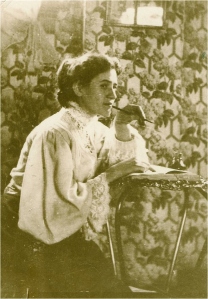
My paternal grandmother, Miriam Reuben Wisoff who was a published poet.
Wonder of wonders, the dream that I considered a lofty one has been realized and I have two novels in print and one on the way. Many thanks go out to my agent, Jeanie Loiaconao who believed in Havah and worked hard to find a home for her at Argus Books.
So begins the next leg of the journey. Marketing. Book Signings, interviews and social media are all part of the modern world of marketing. The author must become the promoter.
Having said all that, I come to conclusion of this blog post. One thing that sells a book is a great review. Goodreads, Barnes and Noble and Amazon are good places. Currently PLEASE SAY KADDISH has 48 reviews on Amazon and FROM SILT AND ASHES, 9.
If you’ve read and enjoyed (naturally I hope for positive reviews) please consider taking a few minutes to leave a review. This author humbly thanks you in advance.
Note: For overseas friends, please copy your comments into Amazon.com in addition to leaving them on the UK or other sites. I’m not sure why this doesn’t carry over. I think it should.
Summer is the time for vacations, picnics on the beach and reruns on the telly. For me it has been a time to meet a deadline in July for my third novel in my series entitled AS ONE MUST ONE CAN. These are happy times! The deadline has been met, but there are edits to do and more business ahead. So the Summer Showcase will continue for a few more Fridays. Many thanks to those of you who responded to my plea for your favorite reruns.
The following photo is the PROMPT. This week’s retread request is from CEAYR. If you’re one of those who wrote a story for this prompt feel free to re-post it and enjoy the respite. Remember that all photos are private property and subject to copyright. Use other than Friday Fictioneers by permission only.
























 The following photo is the PROMPT. This week’s retread request is from







 Rochelle Wisoff-Fields-Addicted to Purple